Sunday, 19 August 2012

THE 3 MONKS - Management Learnings


 The subject has given me lots of surprising experiences . The activities which happens during the class gives us a practical example of the theories of management  we are supposed to know. Last class we saw a video, a short animated chines movie. I don’t know about others but I loved it. It was a nice break from the usual classes

Please go through the video once.Link given below :


ABOUT THE MOVIE

Three Monks is a Chinese animated feature film produced by the Shanghai Animation Film Studio. After the cultural and the fall of the political Gang of Four in 1976, the film was one of the first animations created as part of the rebirth period. It is also referred to as The Three Buddhist Priests.


PLOT
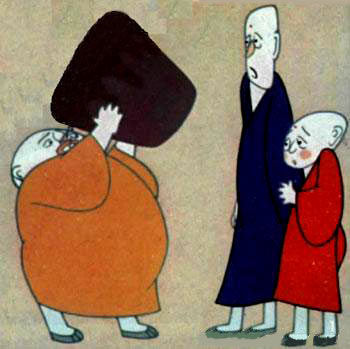
 

A young monk lives a simple life in a temple on top of a hill. He has one daily task of hauling two buckets of water up the hill. He tries to share the job with another monk, but the carry pole is only long enough for one bucket. The arrival of a third monk prompts everyone to expect that someone else will take on the chore. Consequently, no one fetches water though everybody is thirsty. 


At night, a rat comes to scrounge and then knocks the candleholder, leading to a devastating fire in the temple. The three monks finally unite together and make a concerted effort to put out the fire. Since then they understand the old saying "unity is strength" and begin to live a harmonious life. The temple never lacks water again.


ANALYSIS


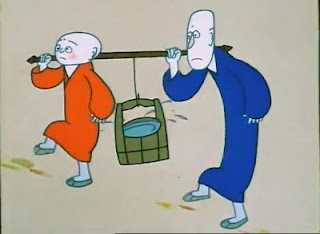
At one point of time the movie shows that two people are 

trying to carry a single bucket, hanging from the bar held on 

their shoulders. Each one tries to push it towards the other 

in order to carry less weight. This is a common scene in 

most of the organisations today where the employees want 

to shift their responsibility to other fellow employees.


When asked in class about the solution to the problem of 
sharing load, a lot of them came up with different solutions.. 
The solution was quite simple - measure the centre using a scale. It can be related to an organisation too. There is always a simple solution. The only problem is discovering it .


Next, we noticed in the video , how the process of bringing 

the water uphill is changed when the second monk arrives. 

The single monk was carrying water everyday, but when the 

second monk arrived, they both started sharing the load. 

They updated the process so that all resources are optimally 

utilized – TEAM WORK .


But ….. the team work was short lived… They started 

transferring their load to each other. This shows the violation 

of the team work principle.


When the third monk comes, the quarrel become even more 

intense. No one was willing to bring water and was ordering 

the other person to do it. Infact, once when the 3rd monk got 

water, after climbing the top, he himself consumed it. This 

shows selfishness in an organisation.


At night when they sleep, we see that the the monastery catches fire. There was no water in the monastery at that time. When this happens, all the monks forget their hostility and try to put out the fire. The dilemma of who will carry the water was quickly forgotten and a system arose out of the initial chaos. They all put out the fire quickly .

Moral :
Many a times crisis situations are encountered where any kind of system is in place. Infact one should be ready for it and should not keep anything for tomorrow and do their work today itself. In the end we see that the monks resolve the situation by fixing a pulley and dividing their roles - hooking the bucket, roping it in and transporting to the monastery.


Sunday, 8 July 2012

Tower building - Goal setting and Management

Data for  Tower Building exercise in terms of No. of CUBES is given below.

Factor  1 to 8
Scenario - I
 Scenario - II
 Scenario - III
 Scenario - IV
 1 & 2
Historical Tower height achieved by team
 Low - 5

High -  18
 Low - 5


High - 20
  Low - 5

High - 21
 Low - 5


High - 23
 3
Achievable Performance -          ( Estimate / Guess )

 18 +

20+

 22+

 25+
4
Goal proposed by the Manager
 18
 22
22
 18
5
Goal proposed by the worker
12
 12
 12
20
 6
Goal Mutually agreed for building the tower between worker and manager with the support of the manager
  15
22
 18
  15
 7
No. of cubes Tower manager and worker team could build / achieve at the end of the exercise
18
 18
 18
18
8
P O T E N T I A L
T O W E R  
H E I G H T  

20
25
25
30

 Potential tower height as per my understanding is stated above.


 Sl. No.
Measure for Managerial Excellence
 Scenario - I
 Scenario - II
 Scenario - III
 Scenario - IV
 1


2


 3


 4


 5


6


7


8
1. Gap if any between Tower height Performance so far achieved and Achievable performance of tower ( Factor 3 and 7)


2. Gap if any between goal proposed by the manager and mutually agreed goal by team
 ( Factor 4 and 6)


3. Gap if any between goal proposed by the manger and the goal proposed  by the worker 
 ( Factor 4 and 5)


4. Gap if any between goal proposed by the worker  and mutually agreed goal by team
 ( Factor 5 and 6)


5. Gap if any between achievable performance  and potential tower
 ( Factor 3 and 8)

6. Gap if any between  performance achieved ( at the end of the exercise ) and  goal mutually agreed by manger and the worker  
( Factor 6 and 7)
7. Gap if any between  performance achieved ( at the end of the exercise ) and  achievable goal  
 ( Factor 7 and 3)


8. Gap if any between  performance achieved ( at the end of the exercise ) and  the potential  
 ( Factor 7 and 8)
Acheivable performance = Performance of team.
This is a condsiderable situation with drawback being that limits are not being pushed.


Team performed better than what was earlier decided mutually.


Manager has high expectations.
Employees are complacent.


Mutual agreement lies in middle of worker and manager aspirations.


Exceeded expectations.


Yes.Gap does exist.This is a condsiderable situation with drawback being that limits are not being pushed.

Acheivable performance > Performance of team.
 Team did not push their limits and performed below expectations.


Team performed as  what was earlier decided mutually.


Manager has very high expectations.
Employees are complacent.


Mutual agreement is completely manager aspirations.He has been able to convince workers of his goals.


Performance below expectations.


Yes.large Gap does exist.Team did not push their limits and performed below expectations.
Acheivable performance > Performance of team.
 Team did not push their limits and performed below expectations.


Team performed not as good as what was earlier decided mutually.


Manager has very high expectations.
Employees are complacent.


Mutual agreement lies more towards manager aspirations.
Workers have been successful in negotiating a little.


Met expectations.


Yes.large Gap does exist.
Ac heivable performance is much  greater than Performance of team.
 Team did not push their limits and performed very badly and  below expectations.


Team performed not as good as  what was earlier decided mutually.


Manager has low expectations.
Employees are motivated and have set high expectations.

Mutual agreement is lesser than worker and manager aspirations.
Poor manager will eventually lead to complacent employees.


Exceeded expectations.


Yes.very large Gap does exist. Team did not push their limits and performed very badly and  below expectations.